Tuesday, April 26, 2011

Strange Bedfellows: PBS Culture Mafia, "Christian Right," and Former Met Kingpin at Upcoming Museum of Biblical Art Gala

Not that there's anything wrong with lending your prestige to an entity that hasn't filed tax returns for the last two years, is controlled by the seemingly right-wing American Bible Society, and whose chair, Roberta Ahmanson, is half of an Evangelical power couple who continues to deny, sort of, that she advocates an official American theocracy.

That's what PBS luminary Bill Moyers (right) and former Met director Philippe de Montebello (below left) will be doing come May 2, when they'll preside as the honorary co-chairs of a fundraising bash for said entity, the Museum of Biblical Art in Manhattan.

Moyers, one sometimes forgets, has a master's of divinity degree, and he's hosted several television programs on religion.  De Montebello, of course, headed up a museum that has boatloads of Christian biblical art.

Besides, they both have a professional relationship with the gala's honoree, William F. Baker (below right), former president and now president emeritus of WNET, New York's PBS television station, which hosts de Montebello's Sunday arts program and has aired various incarnations of Moyers' programs.

MoBIA is honoring Baker with its first Visionary Award for "his creative leadership in the world of art and religion."  He produced the PBS film "The Face:  Jesus in Art" and its follow-up, "Picturing Mary."

He's also one of MoBIA's founding and current trustees, a board membership conspicuously absent from his lengthy bio on WNET's website.

Some facts to chew on when these culture hotshots rustle up the bucks for MoBIA next week:

Although a separate organization, MoBIA is really an arm of the American Bible Society, whose mission, to quote its tax filings, is "to make the (Christian) Bible available to every person in a language and format each can understand and afford, so all people may experience its life-changing message."  In those same filings, the American Bible Society identifies MoBIA as a "controlled entity," meaning that the Society either has the power to appoint the majority of MoBIA's trustees or the Society's own employees or trustees are a majority.

According to MoBIA's latest tax filing (for fiscal year ended June 30, 2008), the two organizations share a key employee, Peter F. Rathbun, the Society's general counsel and a founding trustee of MoBIA.

Rathbun's also president of the Christian Legal Society.  Its first objective is "to proclaim Jesus as Lord through all that we do in the field of law and other disciplines."

The American Bible Society gives MoBIA substantial ongoing financing.  According to MoBIA's most recent filing, the Society provided $1.3 million of MoBIA's $1.8 million in revenues.  In its last filing (for fiscal year 2010), the Society's return lists $1.6 million in financial support and in-kind services.

And then there are Howard and Roberta Ahmanson, who have been dogged by their support -- now somewhat tempered -- for the reviled Christian Reconstructionist R.J. Rushdoony, who advocated the imposition of Christian law and the stoning to death of homosexuals.

Roberta Ahmanson is MoBIA's current chair.

The Ahmansons are also, as quoted in a recent Christianity Today feature, the self-described "single largest supporter" of the "Intelligent Design" movement, "and have been from the beginning."

According to the Chronicle of Philanthropy, the Ahmansons gave MoBIA $1.2 million in 2009 -- somewhat less than the $1.395 million they donated, according to the San Francisco Chronicle, through their company Fieldstead to the passage of California's anti-gay-marriage Proposition 8.  MoBIA's website acknowledges their continuing support.

If you don't like the sound of this but still want to see MoBIA's art exhibits, some of which are very good indeed, admission is pay what you wish, perhaps because it gets funds from New York City via City Council grants and the Department of Cultural Affairs.  DCA's website shows an award of $98,400 for fiscal 2011.

In the meantime, maybe Moyers or de Montebello can goose MoBIA into filing its 2009 and 2010 tax returns.

Photos have been pulled from the internet.

Monday, April 18, 2011

Gagosian's "Picasso and Marie-Therese: L'amour fou": An Olympian Takes a Tumble, Shows the Fool

Sometimes when the gods come down from Olympus and meddle in human affairs, they come across as fools.

Consider that Picasso was 45 when, in 1927, he landed the 17-year-old Marie-Therese Walter, the subject of this show, as his mistress.  It's already ridiculous.

So maybe it won't surprise that there's some silliness at Gagosian's "Picasso and Marie-Therese: L'amour fou" (which translates as "wild love").

Try reading Picasso's mash note, enlarged as a wall text exhibit, with a straight face: "I love you more than the taste of your mouth, more than your look, more than your hands, more than your whole body, more and more and more and more."  He also writes his and his lover's initials on a simple paper cutout of a dove, like a schoolboy carving initials on a tree.

As a record of Picasso's decade of intoxication with his blond mistress,  "L'amour fou" is telling."*  As art, alas, not so much, even though with 81 works and 13 photos it's larger than some museum shows.

There are portraits galore, in fact too many -- Marie-Therese wearing a red beret (several of these), wearing a hat (likewise), with a garland in her hair (at least two), with a fur collar, with colorful buttons.  Many are repetitive (compare the two above), and show a man obsessed with . . . well, it's hard to tell what he's obsessed with because Marie-Therese is usually a blank.

A few exceptions are here, of course (it's Picasso!).  A 1935 portrait (top) with a lilac and green ground and bold black outlines, where the only thing that seems anatomically correct are the lips, is beautiful and meaty with great physical presence.

And in two portraits of their daughter -- born shortly before he took up with Dora Maar -- Picasso, painting in a childlike style, is again the rebellious innovator (above left).

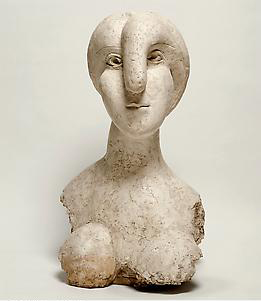
Aside from the portraits, erotic imagery is abundant:  a strong, large plaster bust where the nose is a phallus (left); small, 16-inch-high bronzes that are nothing but a small head and large breasts on a stick.

And then there are the voyeuristic paintings: the naked Marie-Therese as mounds of breasts and hips, on her back, in an armchair (below), embraced by another woman, or simply sprawled across the diagonal of the canvas; and the clothed, submissive Marie-Therese reading or sleeping or sketching with her sister.

These fantasies are easy to understand and easy on the eyes.

They have none of the iconographic or pictorial richness of, say, MoMA's great Marie-Therese painting, "Girl Before a Mirror," with its themes of Vanitas, sexual transformation, and psychological complexity.  Nor do they have the aggressive sexual power and compositional virtuosity of the Marie -Therese painting recently installed at the Tate.

But Picasso is never without some genius, and on display here is a voracious inquisitiveness.  The sheer variety of styles unleashed in a variety of media -- oil, ink, pencil, pastel, cut paper, crayon, etching, bronze -- is in itself stunning.  There's even a plaster relief of his lover's profile that would make a fitting grotto decoration.

The best work here, though, is one where Marie-Therese does not appear as herself at all, but as a figure holding a candle before a fumbling, helpless man-bull in one of the greatest prints of the 20th century, the "Minotauromachy" (below).

Gagosian set the bar high in 2009 when the gallery reexamined works from Picasso's last decade, a show that made people gasp with the pleasure of discovering a Picasso in his 80s staring down death.  The Times called it "one of the best shows to be seen in New York since the turn of the century," and I don't know anyone who disagreed.

By contrast, the Picasso of Marie-Therese is fairly well known, including most of the better works on display (some were shown by Acquavella Galleries in 2008, some have been lent by New York museums).

So we don't see much new in style or subject matter, we just see more, and a lot of that is second-rate.

*Picasso biographer and co-curator of "L'amour fou" John Richardson has described the circus that was Picasso's private life at this time.

According to him, Picasso, married, kept Marie-Therese a secret, and in 1936, shortly after the birth of their child, he took up with Dora Maar.  The story goes, although who knows whether this isn't Picasso spinning his own legend, that the two women met at his studio unexpectedly -- while he was painting "Guernica," no less -- and demanded that he choose between them.  Picasso, happy with the status quo, told them to fight it out between themselves.  Thereupon, a catfight -- or was that just wishful thinking?

Picasso described the brawl to a subsequent mistress as "one of his choicest memories."

The artist continued to be involved with both women until Marie-Therese dropped out of the picture around 1940.  She committed suicide in 1977.  (Dora Maar, for her part, had what used to be called a nervous breakdown.)

Their granddaughter, an art historian, convinced family members to lend to "L'amour fou" and is one of its curators.

"Picasso and Marie-Therese: L'amour fou,"  Gagosian Gallery, 522 West 21st Street, through June 25.

Photos:  Top and plaster bust, from Gagosian website; the others were pulled off the internet.  All images Copyright Artists Rights Society.

Tuesday, April 12, 2011

"Richard Serra Drawing": Artist Recreates Decades-Old Works for Met Retrospective; Refers to His Drawings as Just "Material"

At the retrospective of Richard Serra's drawings, which opens at the Met tomorrow and is the first to cover 40 years of his work, you won't always be seeing the originals, though that's not clear from the display cards.

Also, some works face having portions chopped off when they go on tour.

Perhaps the most interesting surprise is that Serra, with the Met's acquiescence, has recreated for this show some drawings that he made more than 30 years ago.  The show is arranged chronologically, and the recreations, made in 2011, are shown with works from the 70s, when Serra made the originals.

Why the recreations anyway?  A Met curatorial staffer told this reporter that the first "iteration" of some drawings couldn't be loaned, or no longer existed, or were too damaged to be exhibited.

The damage, he said, was caused by stapling the original works to the walls -- that's how they were meant to be displayed and how the recreations are displayed at the Met -- and the stapling simply put too much stress on what are basically pieces of linen covered with a mass of paintstick.

The recreations seem brawny ("Diamond," above, is one of them), and the original works may have as well -- I asked the staffer if Serra anticipated the damage and he said, "Probably not."

No one is exactly running a hoax here, but no one is exactly explaining it to the person standing in front of the art either.  You'll know which works are recreations only if you read the labels and then catch on that there are two dates, one reading 2011.  In addition, two works (including "Blank," below) are labeled "exhibition copy."


And you can jettison the notion that all Serra drawings are treasured objects.  Some were created as site-specific works, says Serra, and their dimensions are variable, depending on the dimensions of each site.

So "Taraval Beach" (right), which runs floor-to-ceiling and, by the way, already bears two dates, will most likely be trimmed when the show travels.  The Met's ceilings are nearly 20 feet high and are higher than the future stops on this show's tour -- the Menil Collection and SFMOMA.  Art by the yard, cut and chop?

I asked Serra himself on Monday about the integrity of altering his original drawing by cutting it.  He just shrugged, stating, "It's (only) material."

These drawings, he said, are more about the work "as perception than as something precious," adding that he'd be "happy" as long as one version exists.

This attitude is so provocative -- is Serra more radical than we thought? -- why not bring it out in the open?

Photos:  Laura Gilbert.

Sunday, April 3, 2011

Eisenhower Speech to Metropolitan Museum on Soldiers' Lives vs Art in Wartime; Provocative 1946 Audio Found in Met's Archives

A recording of a speech by soon-to-be U.S. President but then-General Dwight Eisenhower a year after World War II ended, addressing the conflict between soldiers' lives and saving cultural monuments, has been found in the Metropolitan Museum's archives.

In a unique commentary by perhaps the most famous general of the 20th century, Eisenhower's remarks on preserving life versus preserving European art would have confounded some New Yorkers -- according to several historians, you couldn't walk down a street in the city without finding a grieving family.  There were more than a million American casualties in that war, with more than 400,000 soldiers dying.

In his speech Eisenhower stated that soldiers' attempts to preserve monuments sometimes went "beyond" the limits of "military prudence." His words still resonate today, when the U.S. is involved in military actions in the art-rich Middle East.

The discovery of the recording (the Met had published the speech shortly after it was given) was announced Friday by the Monuments Men Foundation, whose director, Robert Edsel, found it while doing research at the museum.

Eisenhower made his comments when the Met presented him with a lifetime fellowship in recognition of his efforts to preserve cultural monuments during World War II.

Eisenhower, in December 1943, had ordered that cultural monuments in Italy were to be respected "so far as war allows."  In May 1944, just before the invasion of France, he warned that "it is the responsibility of every commander to protect and respect these symbols whenever possible."  After the German surrender in May 1945 he directed that repositories be set up to process artworks and other objects recovered in Germany and Austria.

Much of Eisenhower's speech is taken up with the platitudes one would expect -- soldiers being exposed to different cultures, for example, and a return to cultural values in peacetime  -- but it is notable for a couple of exceptionally provocative statements.

'Unbridgeable Gulf'

What must his audience have been thinking when he spoke of the soldier and the artist as opposites?

He referred to himself as a "representative of the science of destruction" and stated that the soldier's "necessary association with lethal weapons would seem to imply the existence of an unbridgeable gulf between his philosophy and that of the artist.

"Perhaps this is so."  And again: "War is essentially destruction . . . and in this process much of the world's heritage in art has been inevitably damaged or lost."

Consider, then, Eisenhower's statement that soldiers "tried, within -- and sometimes beyond -- the limits of military prudence, to protect and preserve these products of man's creative instinct."

With the phrase "and sometimes beyond" the limits of military prudence, was he implying that preserving art sometimes took precedence over preserving American lives?

Eisenhower also paid tribute to the Army group now known as the "Monuments Men," a handpicked selection of men and women among the elite of museum directors, curators, and academics who tracked, preserved, and repatriated millions of artistic and cultural items stolen by the Nazis.

Reverse Looting?

An adviser to this group, who also lobbied for its formation, was then-Met director Francis Henry Taylor, who spoke at the award ceremony (in the top photo he is at the far right).  James Rorimer, who succeeded Taylor in 1955, was one of the first Monuments Men and was instrumental in the recovery of art treasures.

Ironically, after the war, Taylor supported a proposal to take -- as spoils of war -- a couple hundred German-owned artworks and give them to the National Gallery in Washington, claiming, "The American people had earned the right in this war to such compensation if they chose to take it."

Twenty-five of the Monuments Men signed a "Wiesbaden Manifesto" objecting to this reverse looting, warning that "no historical grievance will rankle so long, or be the cause of so much justified bitterness, as the removal, for any reason, of a part of the heritage of any nation."

The works were taken anyway, ostensibly for their preservation, and exhibited at the National Gallery to record crowds -- nearly 1 million people in 40 days.  They were later shipped back to West Germany.  Some works were not reunited with their museums in East Germany until Germany's own reunification in 1990.

Eisenhower's speech can be heard here.  A transcript can be read here.

Photos:  Top, Eisenhower speaking at the Met, April 2, 1946, Copyright Metropolitan Museum of Art; middle, Eisenhower with recovered art at the Merkers salt mine, and bottom, future Met director James Rorimer supervising soldiers at a castle in Germany, National Archives.

Friday, March 25, 2011

Prince Adds More Hired Guns in Appropriation-Art Wars After Court Bashes Him & Gagosian For Piracy

Appropriation artist Richard Prince (below right) has decided to appeal the smackdown he received last week in Federal Court.

The court ruled that he had infringed the copyright of photographer Patrick Cariou (below left) by using "at least" 41 photographs from Cariou's book "Yes, Rasta" in a series of paintings by Prince called "Canal Zone" that had been exhibited at the Gagosian Gallery in Manhattan.

Prince has now hired the big-gun law firm Boies Schiller & Flexner for the appeal, it was reported today by "The American Lawyer."  An announcement is also on the firm's website.

Prince, in his losing effort, had argued to the court that his use of Cariou's photographs came within the "fair use" exemption of the copyright law, which allows limited borrowing for reporting, commentary, and the like.

But the Federal District Court in Manhattan held that for "fair use" to apply, the new work must be "transformative" of the original.  Prince's work (one from "Canal Zone" is shown below) was not transformative, the court found, because it did not "in some way comment on, relate to the historical context of, or critically refer back" to Cariou's work.

Under this test, Prince helped sink his own case by testifying at deposition that he had no interest in the meaning of Cariou's photographs.

Court to Collectors:  'Hide 'em'

The decision seems to have caused a kind of panic among some in the art world, not least because the court ordered that unsold "Canal Zone" works be surrendered for "impounding, destruction, or other disposition, as Plaintiff determines," and that owners of the works from the series be informed that they cannot legally display the infringing paintings.  (As recited in the decision, eight works sold for a total of $10.48 million and seven were exchanged for works of art valued between $6 million and $8 million.)

The apparent cherry on the sundae was the court's finding Gagosian also liable as both a direct and contributory infringer.

Boies Schiller is no stranger to high-profile cases.  It was the losing firm in Bush v. Gore and is now involved in the attempt -- successful in the lower court but now on appeal -- to overturn California's Proposition 8, which outlawed gay marriage.

Boies is also hugely expensive -- check out a retainer agreement here, with its nonrefundable retention fee of $250,000. The firm racked up $7 million in fees defending the Andy Warhol Foundation in an authenticity lawsuit, and that case never even went to trial.  (The plaintiff dropped his suit because he could no longer afford to litigate, he said.)

Photo of Patrick Cariou courtesy Vincent Prat.  Photo of Richard Prince from Wikipedia (taken by Nathaniel Paluga).

Tuesday, March 22, 2011

Rarely Seen Medieval Manuscripts at the Met: Solomon's Temple Now, Passover Whimsy Next

How did medieval scholars imagine Solomon's Temple?  One concept is the elevation of the Temple shown right.  It's one of six illustrated manuscript leaves, acquired this year by the Met, from one of the most important biblical commentaries of the late Middle Ages, Nicholas of Lyra's "Postilla Litteralis."

Unannounced, the Met has put two of them on display: the elevation and the curtains of the Tabernacle (below), described in Exodus as "violet and purple, and scarlet twice dyed."

They're big -- 16.5 x 9.75 inches -- and so beautiful in their simplicity that it's a shame the Met isn't exhibiting the other leaves as well.  They show the floor plan of the Tabernacle, the "brazen sea" (a large basin in the Temple), Levite camps around the Tabernacle, and an initial "V" in a commentary on Nehemiah.

Nicholas (1290-1349) was on the theological faculty of the University of Paris.  Like other medieval commentators -- the Bodleian Library has a nice array of illustrations here-- Nicholas made his own architectural drawings to illustrate his text.  Whether the Met's new acquisitions follow his drawings, I can't say.  They're dated 1360-80, not too long after his death.

The "Postilla" occupies an odd place in exegetical history, almost a bridge between medieval Jewish scholars and Reformation theologians.  Nicholas argued that the literal meaning of the Bible was preeminent, and, though he wrote anti-Jewish tracts, he looked to earlier Jewish commentators like Rashi (1040-1105) to determine its meaning.

Yet, the "Postilla" also had a profound influence on 16th-century Reformers, so much so that it was said: "If Lyra had never played his harp, Luther would never have danced."

In other news on the medieval front, what's a great encyclopedic museum like the Met to do when it's left a group pretty much out of the encyclopedia?  Well, for one thing, it can work out some loans.

A couple of years ago, the Met started partnering with the Jewish Theological Seminary up on 120th Street to exhibit, one at a time, some Jewish illuminated manuscripts from JTS's collection.  One of these was included in the Met's magnificent 2009 exhibition "Pen and Parchment: Drawing in the Middle Ages."

In early April the Met is initiating a three-year-long series of loans of Jewish illuminated manuscripts from other American and European institutions.  It's starting with the Washington Haggadah from the Library of Congress, dated 1478 and signed by the scribe and illuminator Joel Ben Simeon, who worked in Germany and Italy.

The Haggadah tells the story of the Israelites' exodus from Egypt and is read at the Passover seder, a joy-intended meal during which four glasses of wine are drunk.  The Washington Haggadah is tempera and gold -- and, from what I've read, wine stains -- on parchment, a luxury item that was actually used.

The pages of the Haggadah will be turned each month, so there will be an opportunity to see several of its sometimes whimsical illustrations.  One page, for example, shows a man roasting meat while blotto from drinking wine.  During the seder, the door is opened for Elijah, a symbolic welcome to the Messiah.  In the Washington Haggadah it's not just Elijah who approaches but his whole family, who jostle for position on a donkey (above).

Hebrew illuminated manuscripts generally do not have a style that distinguishes them from Christian illuminated manuscripts from the same region, but there's at least one difference.  Hebrew text does not have capital letters, so instead of the initial capital letters that are decorated in Christian manuscripts, we find an entire word writ large.

The Washington Haggadah will be exhibited with contemporary works of medieval art in other media from April 5 through June 26.

Metropolitan Museum, Fifth Avenue and 82nd Street.

Top two photos:  Laura Gilbert.

Thursday, March 10, 2011

"Glenn Ligon: America" at the Whitney

Glenn Ligon is good, without doubt -- intelligent, subtle, probing, witty, sometimes billiant, and most emphatically not a trickster.  We see a lot of that in "America," his just-opened midcareer retrospective at the Whitney, which gathers about 100 works.

But the show runs out of steam.  Once we leave the 1990s, when Ligon -- who's black and  gay -- was able to harness themes of racial and sexual identity like no one else, his work as seen here loses its urgency and a lot of its force.

The show is arranged chronologically beginning in 1985, when Ligon was both struggling to get the Jasper Johns monkey off his back and grappling with sexuality and the dilemma of race in American culture, themes that would henceforth permeate his art.

A room with 10 text-based works, with his signature stenciling with paintstick, follows (shown here, a detail from a work with text by Jean Genet, which Ligon changed to the first person).  His own text, "I lost my voice I found my voice," is the equivalent of what's happening artistically.  The pictorial rhythms are sensual, sophisticated, and assured.

But I'd guess we wouldn't be looking at these works now were it not for what followed.  In 1993 Ligon made works for an installation at the Hirshhorn Musseum, "To Disembark," much of which is reassembled here.  It's a meditation on the legacy of slavery in which Ligon plays the starring role.  It's hilarious and tragic at the same time.

One portion is based on the broadsheets by which slave owners advertised for their runaway slaves.  Each runaway is Ligon (above), in one described as "distinguished looking," in another "timid," in a third "a little hunky, though you might not notice it with his shirt untucked."

Another portion is based on the frontispieces of  slave narratives using 18th and 19th century typographic conventions.  Again, each is by and about Ligon.  One reads: "Glenn Ligon, a colored man who at a tender age discovered his affection for the bodies of other men, and has endured scorn and tribulations ever since.  Written by himself."  Pitch perfect.


The other seminal piece is "Notes on the Margin of the Black Book" (above), which reproduces every page from Robert Mapplethorpe's "Black Book" -- black men, mostly naked -- interspersed with quotations from a cacophony of voices, including critics, academicians, politicians, patrons of gay bars, and some of the men who posed.

In this work, everyone comes across as an idiot, not least Mapplethorpe himself, who said, "Most of the blacks don't have health insurance and therefore can't afford AZT.  They all died quickly, the blacks."  It's stomach turning.

Beyond this, there's a series of large, beautiful self-portraits, mugshots mostly of the back of his head (below).


Then this show peters out.  Ligon's attempts to engage Richard Pryor's confrontational "that nigger's crazy" sense of humor just seem ill-suited to an artist who teases out complex reflections.  Repeating the jokes on brightly colored canvases doesn't translate, neutralize, or interpret them.  It's an uneven matchup in which Pryor comes out ahead.

There's a room with smaller works that are interesting and personal -- a screenprint of a report card describing Ligon as antisocial and uncomfortable with his body, for example -- but hardly significant as artworks.

Another room has text works from the last decade based on a James Baldwin essay.  These are lush and elegant but ossified, a return to the Johns aesthetic, this time with a sheen that makes them seem sterile (above left).  Most disappointing, though, is the second-to-last room, in which Ligon as master appropriator uses the art of children he taught (right).

Perhaps his recent neon works will open a more engaging chapter.  Ligon's splendid "Negro Sunshine" beaming out onto Madison Avenue (below) is the artist at his best, rediscovering a vocabulary -- here Gertrude Stein's -- and using it in a new way.

"Glenn Ligon: America," Whitney Museum of American Art, Madison Avenue at 75th Street, through June 5

Images:  Third from bottom, "Mirror," 2002. Collection of Mellody Hobson.  Copyright Glenn Ligon.  Courtesy of the artist and Regen Projects, Los Angeles; second from bottom "Sun (Version 2) #1," 2001.  Collection of Eileen Harris Norton.  Copyright Glenn Ligon.  Courtesy of the artist and Regen Projects, Los Angeles; all other photos by Laura Gilbert.