Showing posts with label gagosian gallery. Show all posts

Friday, October 28, 2011

In Richard Prince Copyright Case, Who Bought the Infringing Paintings and How Much Did They Pay? EXCLUSIVE

Richard Prince, "Specially Round Midnight," purchased by Steven A. Cohen for $2.43 million
In this reporter’s ongoing investigation into Cariou v. Prince -- the court case that found appropriation artist Richard Prince, Larry Gagosian, and the Gagosian Gallery had all infringed photographer Patrick Cariou’s copyright – names and dollar amounts are becoming available.   

The U.S. District Court – whose decision is being appealed, of course – has enjoined the buyers from displaying the works in public, and that order stands.

Copyright experts and even Prince’s own attorney think that injunction makes it all but impossible for these collectors to sell the paintings.  Their current value is thus pretty close to zero.

According to documents filed in the Second Circuit Court of Appeals on October 26, leading the list of purchasers of what the court termed “unlawful” paintings is none other than Steven A. Cohen, one of the biggest collectors of contemporary art and head of controversial hedge fund SAC Capital Advisors.

Steven A. Cohen
SAC, which has for years been publicly remored to have engaged in unlawful activity of its own, has provided investors with remarkably consistent and high above-market returns, even in down markets.  The Feds suspect hanky-panky, and recent news reports in the Wall Street Journal and elsewhere indicate that an investigation is ongoing.

For Prince’s work, Cohen apparently paid the most of any buyer, purchasing “Specially Round Midnight” for $2.43 million.  Easy come, easy go?

Other buyers include Michael and Lise Evans, who bought “Mr. Jones” for $2 million, art dealer Jeanne Greenberg Rohatyn, collector Adam Lindemann, and shipping magnate Philip Niarchos.

What follows is a list of works declared unlawful and sold through February 2009 and the prices paid:

“Specially Round Midnight,” $2.43 million

“Mr. Jones,” $2 million

“Escape Goat,” $2 million

“Canal Zone,” $1.2 million

“The Other Side of the Island,” $1.2 million

“Naked Confessions,” $450,000

“Untitled (Rasta)," $400,000

One buyer, whom I have not yet been able to identify, wanted to buy three paintings – “Back to the Garden,” “Cookie Crumbles,” and an untitled work.  But he had cash flow problems, so he traded a Richard Serra sculpture for them.  Gagosian Gallery, which is Prince’s dealer, got the sculpture, the buyer got the paintings, and Prince got money.

In addition, Prince traded four of his “Canal Zone” paintings for a work owned by Gagosian, “Dying and Dead Veteran” by Larry Rivers, estimated to be worth between $3 million and $4 million.

Stay tuned, as I’ll be breaking a lot more news over the next week.

Two images from Patrick Cariou's "Yes, Rasta" that Prince used in creating "Specially Round Midnight" (top)
Image of Cohen pulled from the internet.  "Yes, Rasta" images Copyright Patrick Cariou.
Text Copyright 2011 Laura Gilbert

Sunday, July 24, 2011

Cariou v. Prince Update: Collectors Screwed, Appeal Stalled in Copyright Case That Has Art World on Edge

How do you inform a collector that a work he bought from you for, oh, a million dollars or so is an illicit work, illegally created and now unsaleable?  Well, if you’re the gallery that sold it, you yell for your lawyers.

That’s what Larry Gagosian and his gallery did when they sent letters to the buyers of appropriation artist Richard Prince’s “Canal Zone” paintings, which, the U.S. District Court in Manhattan ruled in March, infringed -- some might say “stole” -- Patrick Cariou’s copyrighted photographs and are therefore not so different from contraband.  

The letters (left) were sent to comply with the Court’s order in that case, but they didn’t exactly tell the collectors they had all but thrown their money away (unless the ruling is overturned on appeal, which could take years).

The letters stated that “in the opinion of the Court” – as though the federal courts are art critics instead of constitutionally delegated authority on the law of the land –  the paintings were “not lawfully made under the Copyright Act of 1976” and they “cannot lawfully be displayed . . .in the public.”

Translation: the paintings are like pirates’ booty, have to be hidden from public view, and, even according to Prince’s own lawyer, most probably can’t be resold.  According to the defendants’ documents, at a minimum 14 works were sold, and four sold for prices ranging from $400,000 to $2.43 million.

As for Prince himself, the Court’s smackdown doesn’t seem to have changed much, though it could cost him a big hunk of money.  As far as his lawyer Josh Schiller of Boies Schiller knows, the decision hasn’t changed his practice of using other people’s images, nor has it caused “any of his works to be pulled” from any shows, the attorney told this reporter.

Indeed, Prince had two well-received exhibitions in Paris this spring and another in Hongkong.  In August, he’ll be showing in the Hamptons.

Paintings Can’t Be Sold

For the “Canal Zone” buyers, though, it’s a different story.  Their paintings can’t be sold, except conceivably on the black market.  Schiller said “any kind of sale would include showing (the work) publicly” and that’s been forbidden by the Court.

Schiller didn’t say the “Canal Zone” paintings were now worthless – he described their worth as “undetermined” – but he did say that the decision had placed an “implied limit on their value.”  He termed the decision’s effect on the collectors “an injustice.”

Larry Gagosian
A lawyer close to the Gagosian organization said that if the collectors were his clients, he would advise them not to put the paintings up for sale.

Copyright law expert David Wolf, who is not involved in the case and is former litigation counsel at Time Inc., said that any third party who knew about the Court decision and tried to sell the work – not just the owners but an auction house, for example -- “would run a pretty severe risk.”

Have any collectors asked for their money back?  Schiller said he didn’t know.

So are Prince’s dealer and co-defendants Larry Gagosians and his Gagosian gallery offering buyers refunds?  When asked, the gallery refused to comment.

Price Revelations

That’s not all the collectors have to worry about, as revealed to this reporter by the parties’ lawyers this week and gleaned from Cariou’s recent motion to dismiss a joint appeal to a higher court by Prince, Gagosian, and the gallery.

The people who shelled out the big bucks -- as recited in the Court’s decision, eight of the works sold for a total of $10.48 million, and seven were exchanged for art with an estimated value between $6 million and $8 million -- now also could be exposed to the disclosure of how much each paid and, perhaps, their names.

Gagosian Gallery, W. 24th St.
Private market sales are usually kept secret – the industry-wide practice is an old carny shell game of keeping everyone in the dark about an artist’s true prices -- and Gagosian has a strict policy of don’t tell. 

But, in what could be some of the most remarkable revelations of art-market dealings in recent history, that could change when a public jury trial is held to determine the damages that photographer Cariou suffered.

Cariou’s lawyer Dan Brooks has been provided with the appropriate receipts for each painting sold, and the parties have stipulated that the prices “shall be admissible in evidence.”  For now, the information is subject to a confidentiality agreement, but Brooks said they would be “fully aired” at the damages trial and “there won’t be any dispute” about the prices the works brought.  At trial, the buyers’ names could also be revealed, said Brooks.

If we get to that trial.

Prince and the Gagosian defendants filed a notice of appeal before the damages trial could get started, and the District Court adjourned the trial pending the outcome of the appeal. So Cariou has moved to dismiss the appeal, arguing that it is improper until damages have been resolved – that’s a motion that will be decided who knows when, though it could be as early as August.

Prince’s Lawyer: Court Should Disregard My Client’s Testimony

Meantime, of course, settlement is always a possibility, though it was also a possibility that was ignored before the District Court dropped a ton of bricks on Prince’s and Gagosian’s heads.
 
If the appeal is permitted before the damages trial, Schiller plans to argue among other things that the District Court in effect should have rejected or at least discounted his own client’s testimony – since Prince proved to be his own worst enemy.  The Court “would have benefited,” said Schiller, from considering “more objective factors,” which Schiller didn’t specify, and evidence of “how the public perceives his work.”

Prince
Prince, in his losing effort, had argued that his use of Cariou's photographs came within the "fair use" exemption of the copyright law, which allows limited borrowing of other people’s copyrighted work for news reporting, satire, and criticism, for instance.

But the District Court held that for "fair use" to apply, the new work must be "transformative" of the original.  Prince's work was not transformative, the Court found, because it did not "in some way comment on, relate to the historical context of, or critically refer back" to Cariou's work.

Under this test, Prince helped sink his own case.  He testified at deposition that he had no interest at all in what Cariou's photographs meant.

Focusing on Prince’s testimony is too “narrow” a view of the law, said Schiller, and it means “an artist has to lawyer up to get his perception across.”

(Well, one might rejoin, only if an artist is sued, and then he has to lawyer up anyway.)

It could be tough to overcome Prince’s testimony.  “Whatever arguments they make, the Court will look at Prince’s testimony,” said copyright expert Wolf.  “Anytime the party gives detailed testimony about what he’s doing it’s important.”

What Happened to the Unsold Paintings

The District Court had given Carriou the power to determine the fate of the unsold “Canal Zone” paintings.  We now know what he decided.

It turns out that within days of the Court’s decision, defendants’ lawyers, “expressing concern that the infringing paintings might be destroyed” -- an option the Court explicitly permitted – asked Cariou to agree to store the works until the case is somehow resolved, according to papers filed by Cariou’s lawyer Brooks. 

Cariou acquiesced, so there’ll be no conflagration, at least for awhile. The unsold paintings are now warehoused somewhere in Long Island City.  

Schiller said he thought Prince was a “target” because he was “rich.” But rich also means he may well be able to afford endless, costly litigation – Boies Schiller reportedly racked up $7 million in fees defending the Andy Warhol Foundation in an authenticity lawsuit, with the fellow on the other side finally dropping his suit because he could no longer afford to litigate, he had said.

I asked Brooks if he was concerned that his client would be litigated to death.  Brooks’ response:  “No.”

Copyright 2011 Laura Gilbert

Monday, April 18, 2011

Gagosian's "Picasso and Marie-Therese: L'amour fou": An Olympian Takes a Tumble, Shows the Fool

Sometimes when the gods come down from Olympus and meddle in human affairs, they come across as fools.

Consider that Picasso was 45 when, in 1927, he landed the 17-year-old Marie-Therese Walter, the subject of this show, as his mistress.  It's already ridiculous.

So maybe it won't surprise that there's some silliness at Gagosian's "Picasso and Marie-Therese: L'amour fou" (which translates as "wild love").

Try reading Picasso's mash note, enlarged as a wall text exhibit, with a straight face: "I love you more than the taste of your mouth, more than your look, more than your hands, more than your whole body, more and more and more and more."  He also writes his and his lover's initials on a simple paper cutout of a dove, like a schoolboy carving initials on a tree.

As a record of Picasso's decade of intoxication with his blond mistress,  "L'amour fou" is telling."*  As art, alas, not so much, even though with 81 works and 13 photos it's larger than some museum shows.

There are portraits galore, in fact too many -- Marie-Therese wearing a red beret (several of these), wearing a hat (likewise), with a garland in her hair (at least two), with a fur collar, with colorful buttons.  Many are repetitive (compare the two above), and show a man obsessed with . . . well, it's hard to tell what he's obsessed with because Marie-Therese is usually a blank.

A few exceptions are here, of course (it's Picasso!).  A 1935 portrait (top) with a lilac and green ground and bold black outlines, where the only thing that seems anatomically correct are the lips, is beautiful and meaty with great physical presence.

And in two portraits of their daughter -- born shortly before he took up with Dora Maar -- Picasso, painting in a childlike style, is again the rebellious innovator (above left).

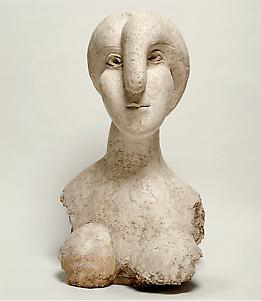
Aside from the portraits, erotic imagery is abundant:  a strong, large plaster bust where the nose is a phallus (left); small, 16-inch-high bronzes that are nothing but a small head and large breasts on a stick.

And then there are the voyeuristic paintings: the naked Marie-Therese as mounds of breasts and hips, on her back, in an armchair (below), embraced by another woman, or simply sprawled across the diagonal of the canvas; and the clothed, submissive Marie-Therese reading or sleeping or sketching with her sister.

These fantasies are easy to understand and easy on the eyes.

They have none of the iconographic or pictorial richness of, say, MoMA's great Marie-Therese painting, "Girl Before a Mirror," with its themes of Vanitas, sexual transformation, and psychological complexity.  Nor do they have the aggressive sexual power and compositional virtuosity of the Marie -Therese painting recently installed at the Tate.

But Picasso is never without some genius, and on display here is a voracious inquisitiveness.  The sheer variety of styles unleashed in a variety of media -- oil, ink, pencil, pastel, cut paper, crayon, etching, bronze -- is in itself stunning.  There's even a plaster relief of his lover's profile that would make a fitting grotto decoration.

The best work here, though, is one where Marie-Therese does not appear as herself at all, but as a figure holding a candle before a fumbling, helpless man-bull in one of the greatest prints of the 20th century, the "Minotauromachy" (below).

Gagosian set the bar high in 2009 when the gallery reexamined works from Picasso's last decade, a show that made people gasp with the pleasure of discovering a Picasso in his 80s staring down death.  The Times called it "one of the best shows to be seen in New York since the turn of the century," and I don't know anyone who disagreed.

By contrast, the Picasso of Marie-Therese is fairly well known, including most of the better works on display (some were shown by Acquavella Galleries in 2008, some have been lent by New York museums).

So we don't see much new in style or subject matter, we just see more, and a lot of that is second-rate.

*Picasso biographer and co-curator of "L'amour fou" John Richardson has described the circus that was Picasso's private life at this time.

According to him, Picasso, married, kept Marie-Therese a secret, and in 1936, shortly after the birth of their child, he took up with Dora Maar.  The story goes, although who knows whether this isn't Picasso spinning his own legend, that the two women met at his studio unexpectedly -- while he was painting "Guernica," no less -- and demanded that he choose between them.  Picasso, happy with the status quo, told them to fight it out between themselves.  Thereupon, a catfight -- or was that just wishful thinking?

Picasso described the brawl to a subsequent mistress as "one of his choicest memories."

The artist continued to be involved with both women until Marie-Therese dropped out of the picture around 1940.  She committed suicide in 1977.  (Dora Maar, for her part, had what used to be called a nervous breakdown.)

Their granddaughter, an art historian, convinced family members to lend to "L'amour fou" and is one of its curators.

"Picasso and Marie-Therese: L'amour fou,"  Gagosian Gallery, 522 West 21st Street, through June 25.

Photos:  Top and plaster bust, from Gagosian website; the others were pulled off the internet.  All images Copyright Artists Rights Society.

Friday, March 25, 2011

Prince Adds More Hired Guns in Appropriation-Art Wars After Court Bashes Him & Gagosian For Piracy

Appropriation artist Richard Prince (below right) has decided to appeal the smackdown he received last week in Federal Court.

The court ruled that he had infringed the copyright of photographer Patrick Cariou (below left) by using "at least" 41 photographs from Cariou's book "Yes, Rasta" in a series of paintings by Prince called "Canal Zone" that had been exhibited at the Gagosian Gallery in Manhattan.

Prince has now hired the big-gun law firm Boies Schiller & Flexner for the appeal, it was reported today by "The American Lawyer."  An announcement is also on the firm's website.

Prince, in his losing effort, had argued to the court that his use of Cariou's photographs came within the "fair use" exemption of the copyright law, which allows limited borrowing for reporting, commentary, and the like.

But the Federal District Court in Manhattan held that for "fair use" to apply, the new work must be "transformative" of the original.  Prince's work (one from "Canal Zone" is shown below) was not transformative, the court found, because it did not "in some way comment on, relate to the historical context of, or critically refer back" to Cariou's work.

Under this test, Prince helped sink his own case by testifying at deposition that he had no interest in the meaning of Cariou's photographs.

Court to Collectors:  'Hide 'em'

The decision seems to have caused a kind of panic among some in the art world, not least because the court ordered that unsold "Canal Zone" works be surrendered for "impounding, destruction, or other disposition, as Plaintiff determines," and that owners of the works from the series be informed that they cannot legally display the infringing paintings.  (As recited in the decision, eight works sold for a total of $10.48 million and seven were exchanged for works of art valued between $6 million and $8 million.)

The apparent cherry on the sundae was the court's finding Gagosian also liable as both a direct and contributory infringer.

Boies Schiller is no stranger to high-profile cases.  It was the losing firm in Bush v. Gore and is now involved in the attempt -- successful in the lower court but now on appeal -- to overturn California's Proposition 8, which outlawed gay marriage.

Boies is also hugely expensive -- check out a retainer agreement here, with its nonrefundable retention fee of $250,000. The firm racked up $7 million in fees defending the Andy Warhol Foundation in an authenticity lawsuit, and that case never even went to trial.  (The plaintiff dropped his suit because he could no longer afford to litigate, he said.)

Photo of Patrick Cariou courtesy Vincent Prat.  Photo of Richard Prince from Wikipedia (taken by Nathaniel Paluga).